Honest take: most people who land here have bought guest posts before. Some were fine. Others paid for links that vanished in two weeks — or never moved anything that mattered.
When you buy guest posts in Europe, “high Domain Rating, please” is not a strategy. A French site with French readers will not rescue your German shop. A niche trade blog in Austria might be exactly what a category page needs.
This is not a pep talk. It is the checklist we use before a placement is worth the money. Prefer German? Read the DACH version of this guide.
Europe is language markets, not one blob
US campaigns often start with English and a metric sort. Europe splits into languages and search spaces. Germany, Austria, Switzerland. France. Benelux. Scandinavia. All “Europe” — rarely interchangeable.
A guest post works here when three things line up:
- the language of the site and your audience
- the topical neighbourhood (not “anything business-shaped”)
- a publisher with real readers — not an empty shell wearing metric makeup
Ignore that and you buy links. Respect it and you buy visibility in a concrete market.

Pick country and language before you open the catalog
Before you browse: one URL, one goal. Sounds dull. It kills half the bad buys.
Questions worth answering out loud:
- Which URL should get stronger — homepage, guide, category?
- Which country and language should see you more clearly?
- Which anchors would look natural (brand, URL, mixed) — and which would look like a stamp?
- What does the current link profile look like? A fresh domain with zero links needs a different pace than a brand with eighty referring domains.
Without those answers, “buy guest posts” turns into an evening of shopping by gut feel. Gut feel is expensive.
DR, DA, and traffic are filters — not religion
Metrics help you sort. They do not replace opening the site. For a deeper metric walkthrough, see how to choose a publisher site. The short version for Europe:
- Floor, not trophy. Set a minimum that matches your budget, then stop staring at the ceiling.
- Compare inside a niche. A DR 40 travel blog and a DR 40 casino network are not the same purchase.
- Watch mismatches. Very high DR with near-zero traffic (or the reverse) deserves a second look at samples and outbound links.

Niche fit, outbound spam, and content quality
Open the homepage. Scroll. Read two articles. If the site feels like a warehouse for paid copy, it usually is.
1. Niche fit before ego metrics
A fintech link on a travel blog may look cheap. Context still matters. For European campaigns we prefer language-matched trade media, regional portals, or blogs that already write about similar problems.
2. Traffic and indexation
Zero organic traffic on a supposedly strong domain? Dig in. Sometimes tools are wrong. Sometimes the domain is a prop. Either way, that is not a “buy now” click.
3. Outbound behaviour
How many paid links already leave the site? Is every paragraph ending in a different affiliate? Healthy publishers place guest posts sparingly. A link supermarket is not where you put your brand.
4. Language and country signals
A .de site with German content is not the same as an English site pitching a “global audience.” Local rankings in the Netherlands or Belgium usually need matching language — and often local publishers — not just a European stamp in a pitch deck.
5. Price versus delivery promise
Extremely cheap “premium” offers usually hide a hook: weak sites, nofollow without agreement, or content nobody reads. Good placements cost something. Expensive is not automatically good. Dumping prices are rarely magic.
Content quality still decides whether the link deserves to exist
The link is only as strong as the article around it. Thin 500-word pieces with forced keywords look worse in 2026 than they did in 2019.
What tends to land better:
- a clear reader benefit — not only “why our tool is great”
- market-local detail (euro prices, local rules, real use cases)
- natural in-content links, not a banner at the bottom
- clean sourcing and byline when the site expects it
If you supply content: write a brief. Target URL, taboos, tone, preferred anchors — and what the publisher may refuse. Vague briefs create revision loops. Revision loops delay live URLs.
Marketplace vs cold outreach
Classic outreach still works. It eats time. In Europe that cost multiplies with every language and country.
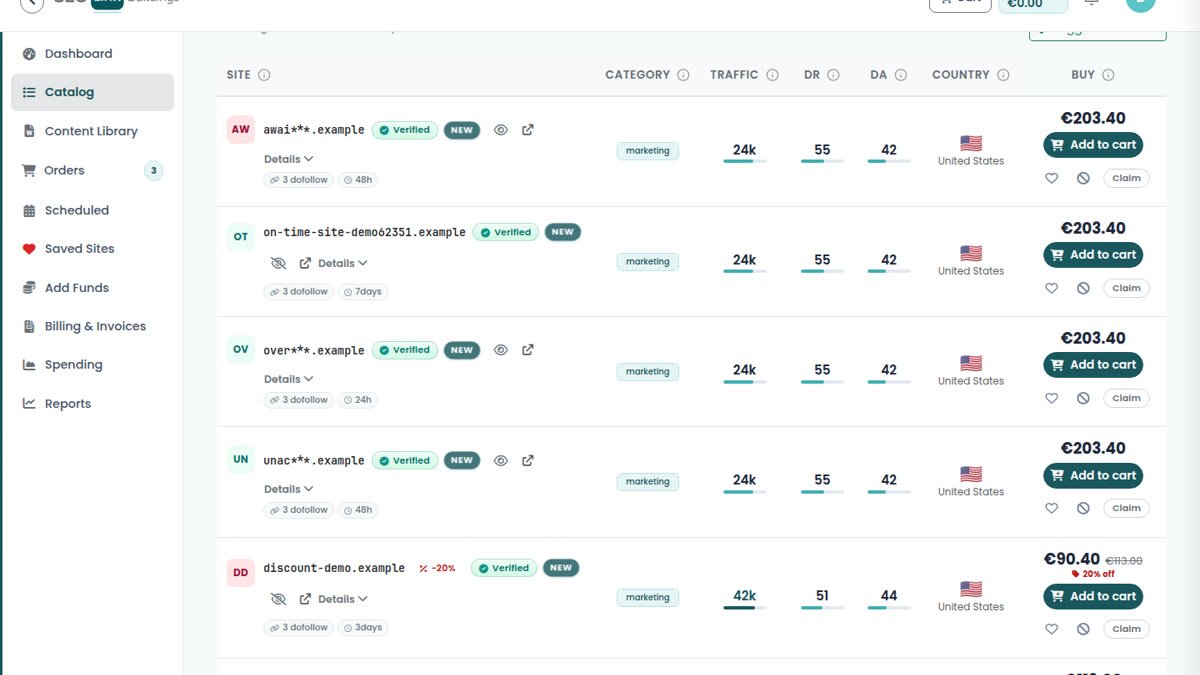
A marketplace like SEOLinkBuildings handles the practical layer: filter by country, language, and metrics; see prices upfront; track the order. That does not replace strategy. It does replace weeks of “friendly reminder” emails to webmasters who never reply.
Create an account, compare matching publishers, and only order when niche and market fit. Unspectacular. That is why it works.
A realistic 90-day plan
No universal formula — but a frame that rarely hurts:
- Weeks 1–2: Lock target URLs and markets. At least know the toxic leftovers in your link profile.
- Weeks 3–6: Place the first 3–8 strong guest posts in the core language, mixed anchors, live URLs documented.
- Weeks 7–12: Add where indexation and engagement look healthy. Do not “fix” weak placements with volume.
Expecting position one in fourteen days ends in disappointment. Still having no idea which sites you booked — and why — after three months means you never solved the real problem.
Bottom line
Guest posts in Europe are not a fifty-link package at a fixed price. It is craft: pick the market, check the publisher, take content seriously, keep a steady pace.
Next time you search “buy guest posts Europe,” skip the ranking-guarantee pitches. Open the site. Read an article. Ask whether your brand belongs there.
Want the short path to compare listings? Numbers sit open in the marketplace — you still decide.
Frequently asked questions
Is a high Domain Rating enough to buy a guest post in Europe?
No. DR and similar scores are filters, not permission slips. Relevance, language, real audience, and the site’s editorial neighbourhood matter as much. A mid-DR site in your market often beats a strong but foreign domain.
How many European guest posts should I place per month?
Steady and selective beats a sudden dump. Many teams start with a handful of strong placements, then add more once indexation and rankings look calm. Pace depends on domain age, niche competition, and how noisy your existing link profile already is.
Are guest posts in France or the Netherlands different from Germany?
The mechanics are similar. The market is not. Language, search intent, and publisher culture differ. A French article for French readers is not the same purchase as a German post on a .de site — even though both sit under “Europe”.
How do I spot risky or artificial publisher offers?
Warning signs: little organic traffic, wildly mixed topics, outbound links on every paragraph, no imprint or contact transparency, and “premium” prices that look like dump-bin deals. If the site does not feel like a real publication, skip it.